ADA Handicap Obtainable Portable Bathroom Rental: Vital Conformity Points
Portable restrooms are simple to deal with as a final line thing. Someone orders sufficient units, selects a shipment spot, and proceeds to car park, food, secure fencing, or the next subcontractor. That is normally where difficulty begins. Access does not sit off sideways as a politeness function. It belongs to whether the toilet setup is usable in all for many individuals attending an event, visiting a website, or moving via a momentary space.
I have seen this play out in extremely average methods. A planner reserves an ada mobile bathroom but puts it on soft ground after a rainfall. A contractor orders the right count of systems but leaves the easily accessible one boxed in behind barriers. An event manager thinks that since the bigger unit arrived, the job is done. On paper, each of those groups might feel near conformity. In method, they have misunderstood that ease of access depends upon the path, the entry, the clearances, the recognition, and the fundamental capacity to get to and use the device with dignity.
If you are setting up an ada mobile bathroom rental, one of the most important point is to think beyond the tag on the door. A certified rental is not just a larger box. It is a short-lived center that still has to meet actual availability requirements.
The government baseline that matters
For mobile bathroom rentals in the United States, the managing federal ease of access requirement is the 2010 ADA Standards for Accessible Style, as analyzed by the Accessibility Board and the Division of Justice. That matters due to the fact that people commonly rely upon routine, supplier shorthand, or obsolete presumptions. Words "mobility device easily accessible" in a sales conversation are not the like actual ADA compliance.
The legal framework is not abstract. It tells you that short-term arrangements still have ease of access responsibilities. If you are dealing with portable single-user devices grouped with each other in a cluster, the scoping regulation is specifically essential. At least 5 percent of the systems in each collection must come, and that concept applies also at temporary events.
That single point improves a great deal of complication. Event coordinators in some cases assume availability needs relax because the installation is just there for a weekend break. They do not. Temporary does not mean optional.
The 5 percent guideline is basic, yet individuals still misapply it
The scoping demand seems uncomplicated, yet this is where numerous rental orders drop off course. If you develop a cluster of portable single-user toilet devices, at least 5 percent of that cluster should be accessible. The essential phrase is "in each cluster." That means availability is not managed by putting one accessible device somewhere else on the home and treating it as coverage for every toilet bank.
This matters on huge websites. If an exterior concert has washroom locations near the entrance, near the food court, and near a VIP section, the accessible-unit matter has to be considered at the collection level, not just in a complete sitewide matter. The useful reason is obvious. An individual needs to not need to travel across the grounds since the only ada certified mobile toilet was positioned in a various zone.
When the mathematics produces a fraction, coordinators ought to not obtain adorable regarding rounding down in spirit. The safer, a lot more considerate method is to make sure the collection actually consists of the required accessible presence. Availability is among those locations where dealing with the minimum as a problem to resolve typically brings about bad positioning and unhappy users.
An easily accessible portable washroom has to be identified
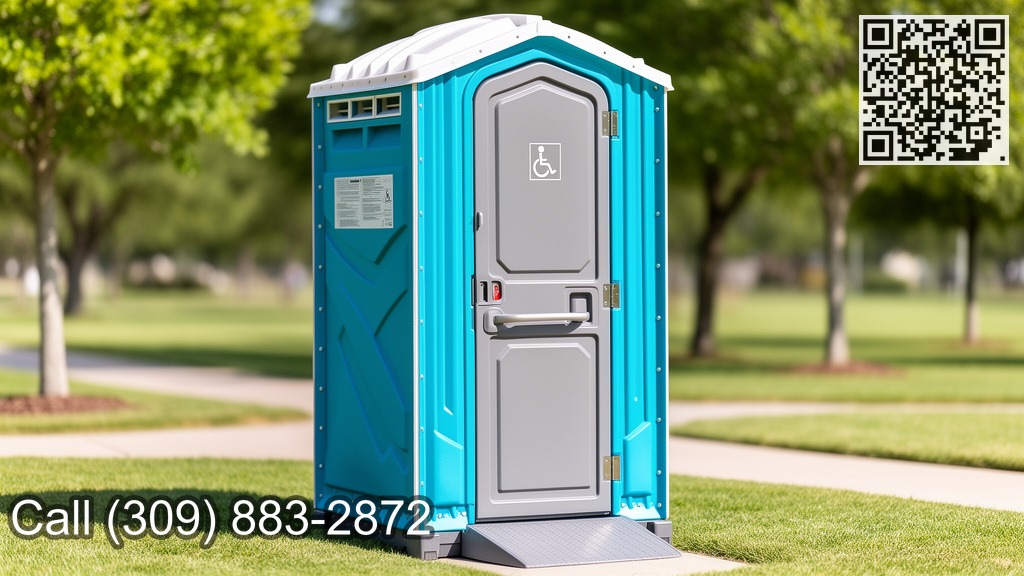
Another factor that gets ignored is signs. Obtainable portable commode units need to be understood the International Icon of Access. This is not decorative. It assists individuals find the proper facility without needing to check every door straight or request help.
That might sound small up until you picture a congested fairground at sundown or a jobsite with dust, tools, and visual clutter. An effectively marked ada handicap accessible mobile toilet lowers uncertainty and quicken gain access to. It likewise signifies to team and safety groups that the system serves a particular objective and should not be obstructed with products, garbage, fencing, or parked carts.
I have actually seen accessible systems come to be informal storage area since they are larger. That is not a safe convenience. A noticeably recognized system is still only beneficial if the setup around it respects what that icon means.
The route to the restroom is part of compliance
This is where lots of or else sympathetic configurations stop working. Mobile easily accessible units need to have an accessible course and entrance. If ramps or landings are required, those attributes additionally have to adhere to the ADA technical requirements.
That suggests compliance does not begin at the limit. It begins where an individual starts approaching the device. If the path is obstructed, unpredictable, muddy, high, or disrupted by short-term obstacles, the obtainable restroom may be functionally not available also if the system itself is technically the best model.
This is one of the most crucial judgment calls in the area. A bathroom supplier may deliver an ada available mobile bathroom that appropriates in itself, but the website host still manages positioning. If the host selects a place throughout deep crushed rock, behind a lip in the pavement, or past a narrow chicane of crowd-control secure fencing, the real-world result can be noncompliant and unusable.
The route concern ends up being even more critical on momentary occasion grounds due to the fact that surface areas transform quickly. A completely dry grassy path on Friday can come to be rutted and soft by Saturday afternoon. Shipments, generators, and foot website traffic can modify access after installment. The lesson is simple: availability needs to be checked once more after the systems are established and once again as the site starts operating.
Inside the unit, technical requirements still apply
The Accessibility Board assistance makes clear that mobile systems need to fulfill toilet-room technical needs, including component clearances, turning room, and door handling clearances, plus appropriate grab-bar and water-closet clearance rules.
That sentence lugs a lot of weight. It informs you that an ada certified available mobile bathroom is not compliant just due to the fact that it is bigger than a basic unit. Inside use matters. People need enough space to enter, maneuver, position themselves, and utilize the components with the assistance includes the criteria require.
It is worth stopping briefly here because this is where marketing language often gets slippery. Suppliers might advertise an ada mobile toilet, an ada-compliant mobile bathroom, or ada certified portable restrooms in wide terms. Those expressions work only if the actual system provided aligns with the technical requirements. A bigger shell without the appropriate clearances or indoor features is not a genuine substitute.
I avoid acting that every planner requires to memorize technical measurements. Many do not. Yet they do require to understand what to verify with the supplier and what to examine on arrival. The wide conformity groups are not optional information. Turning area, clearances, and navigating room are the distinction between access theoretically and accessibility in practice.
Why placement blunders happen so often
A lot of placement mistakes originate from operational stress, okay intent. Groups are attempting to balance vehicle accessibility, pump-out accessibility, appearances, group flow, and offered area. The obtainable device, since it is commonly larger, obtains pressed to the margins. It might be placed where the delivery van can dump it fastest, where there is leftover space behind an outdoor tents, or where it "won't remain in the way."
That instinct normally produces a bad result. The best area for an ada certified portable commode is not the last open port. It is a location individuals can in fact get to and utilize without special assistance. Sometimes that means quiting a cleaner sightline or shifting a barrier run. In some cases it means thinking of drainage prior to the system gets here. Those are clever trade-offs. Access generally obtains much easier when it is part of the first website strategy as opposed to an adjustment after setup.
Another typical trouble is separating the easily accessible unit also much from the various other restrooms. People do this with good objectives, assuming added room around it will aid. Occasionally it does. Occasionally it leaves the user isolated in a much less visible, less practical, or less safe-feeling location. Access needs to support equal usage, not develop a side path unless site restrictions really need it.
The construction-site exception needs mindful handling
There is an essential nuance in the criteria background that individuals in some cases exhaust. The ADA Specifications differentiate mobile commode devices at construction websites utilized solely by building and construction workers, which are exempt from the portable-toilet availability scoping demand in the mentioned 1991 requirement. That does not develop a covering exception for every mobile toilet at every construction-related area, and it does not eliminate the accessible-unit need for general mobile toilet rentals.
This distinction issues since it is easy for job teams to hear "building site" and quit the analysis there. The real context issues. If you are organizing mobile toilets for the general public, visitors, or occasion attendees, the accessible-unit need continues to be pertinent. The exemption language ought to not be made use of as a shortcut to stay clear of planning easily accessible solution where the general public is involved.
That is one of those edge instances where a fast conversation can conserve a great deal of problem. Ask who will certainly make use of the systems, whether the configuration is exclusively for building and construction employees, and whether the rental belongs to a general-access environment. Those questions are much much better than relying upon presumptions connected to the task type.
What renters must confirm prior to delivery
If you are putting an order for ada compliant portable restrooms, a short confirmation action can stop costly reshuffling later. The objective is not to become a code expert overnight. The objective is to ask enough of the appropriate inquiries that the provided arrangement has a fair chance of satisfying the requirements.
- Confirm the amount of units will remain in each cluster and make sure a minimum of 5 percent of each cluster will certainly be accessible.
- Confirm that the accessible units will certainly be related to the International Icon of Accessibility.
- Confirm where the accessible route will certainly start and whether ramps or landings will be needed.
- Confirm that the unit supplied is planned to fulfill the relevant ADA technological requirements for commode rooms.
- Confirm the last positioning after distribution, not simply the order type before delivery.
That five-point check captures many of the failures I see frequently. None of it is glamorous, but it is useful and respectful.
Temporary events are entitled to the exact same severity as irreversible spaces
There is a consistent misconception that pop-up occasions get a pass because they are momentary, congested, and logistically unpleasant. The criteria do not support that perspective. The Access Board assistance particularly uses the 5 percent accessible-unit policy to short-lived events. That should resolve the issue for fairs, races, celebrations, seasonal destinations, and public events of every kind.
The much deeper factor is human, not just lawful. Temporary events are where individuals are often strolling cross countries, standing in lines, navigating unfamiliar terrain, and depending heavily on clear wayfinding. Restroom accessibility matters extra in that atmosphere, not less.
An excellent occasion plan deals with the ada portable restroom as component of visitor experience and threat monitoring at the same time. If the obtainable device is as well far away, hard to determine, or difficult to method in a wheelchair or other wheelchair gadget, the failing is prompt and noticeable. People remember it. Staff spend the rest of the day improvisating around a trouble that should have been fixed prior to entrances opened.
Compliance is broader than one washroom unit
There is also a bigger context worth focusing on. Availability enforcement is not stalling. In April 2026, the Department of Justice issued guidance prolonging the deadline for state and city government web and mobile availability rules to April 26, 2027 for bigger entities. That assistance has to do with electronic access, not portable bathrooms. Still, it shows something crucial: ADA conformity is active throughout fields, and companies are being asked to pay closer interest to gain access to in lots of forms.
For any individual dealing with physical site procedures, this more comprehensive atmosphere ought to be a signal. Availability is increasingly viewed as a complete operational responsibility, not a box to tick in one division. A team that takes care about on the internet gain access to yet laid-back about an ada-compliant mobile commode on the ground is not actually believing holistically. The same holds true in reverse.
Common judgment calls that are worthy of additional care
Not every problem features an intense red flag. A few of the hardest concerns being in gray locations of preparation and implementation. That is why experience matters.
A collection may practically consist of the ideal variety of ada compliant mobile commodes, yet still leave one side of a huge place underserved. A path might appear easily accessible throughout arrangement, after that deteriorate after weather condition or hefty use. A vendor may precisely provide an ada obtainable mobile restroom, while the host weakens conformity by fencing it off too firmly. None of those situations is solved by indicating the purchase order.
The ideal drivers revisit the configuration with the eyes of the person who in fact requires it. Can they discover the system without help? Can they get to it on the available surface? Can they open and utilize it with the room given? Is the device working as meant, or has bordering site task jeopardized gain access to? Those inquiries sound standard, yet they are frequently what divide a specialist setup from a performative one.
When "ADA easily accessible" language gets fuzzy
The rental market makes use of several phrases mutually: ada mobile commode, ada mobile bathroom, ada compliant mobile restroom, ada-compliant portable washrooms, and comparable variations. From a writing and sales viewpoint, that is reasonable. From a conformity standpoint, it can obscure crucial distinctions.
What matters is not the expression itself however whether the provided unit and its positioning line up with the governing criteria. A sales representative might suggest "this is our bigger device." A website manager might hear "this system satisfies everything." Those are not the very same statement. If there is one behavior worth establishing, it is to ask just what is being supplied and just how the website conditions will sustain access.
That is particularly real when multiple parties are entailed. The rental company controls supply. The event organizer manages format. The property owner might regulate the premises. A general contractor may control staging. Availability commonly falls through the voids between them. Clear jobs assist. Somebody requires to possess the matter, the route, the identification, and the last usable condition of the setup.
A sensible standard for obtaining it right
The cleanest method to think about an ada handicap available mobile restroom is this: a person needs to be able to situate it, reach it, enter it, maneuver inside it, and use it without encountering barriers produced by the short-term nature of the site.
That requirement is extra functional than judicial, yet it tracks the conformity points that matter. The unit has https://stephenbsjt377.raidersfanteamshop.com/ada-mobile-bathroom-requirements-every-rental-coordinator-should-testimonial to become part of the appropriate count in each collection. It has to be recognized. It needs to rest on an available route and have an easily accessible entrance. If ramps or landings are called for, those aspects need to comply also. Inside, the technical demands for commode spaces still use, including the required clearances and steering space.
If you keep those fundamentals in view, the remainder of the decision-making obtains more clear. You stop dealing with the obtainable unit as a specialized add-on and begin treating it as a core functional demand. That change usually improves the whole washroom strategy, due to the fact that once teams assume very carefully regarding path, placement, and functionality, every individual benefits.
The configurations people remember for the appropriate reasons
The ideal portable toilet strategies are practically unseen. Guests and workers do not quit to admire them. They simply work. Individuals find the toilets conveniently, relocate to them without problem, and use them without requiring to request for supports. That is what success appears like in this edge of website planning.
An ada portable bathroom leasing done well mirrors treatment before anyone gets here. It appears in the count, the map, the ground conditions, the signage, and the last walkthrough. It likewise lionizes. Not performative respect, not compliance language on an agreement, but the useful kind that lets a person utilize the same event or center with less friction and even more independence.
That is the actual typical worth going for, whether you are getting one ada certified mobile bathroom for a little event or working with multiple clusters of ada compliant easily accessible portable washrooms throughout a huge short-lived site. Conformity begins with the rulebook, but it succeeds in the details individuals actually encounter.
 Ask ChatGPT
 Ask Grok
 Ask Perplexity
 Ask Claude
 Ask Google AI
 Ask You